Insight
AI in charity case management: how to say yes safely
Charities across the UK are now in a position to use AI effectively in case management without compromising the standards they already hold. The technology is mature enough to support day-to-day work, and the safeguards required for safe adoption are available to you with us as your partner. The greatest gains are in the delivery of client-facing services, where controlled AI can reduce administrative load while leaving decisions firmly with staff.
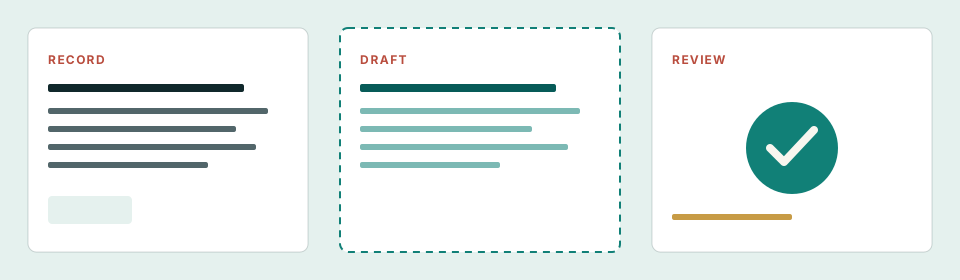
In Seren, AI helps staff draft summaries, find approved records and prepare reports. Nothing becomes part of the record until a person accepts it. The AI can only use information the signed-in user is allowed to see, and we do not train models on client data. Seren is hosted in secure UK data centres in Manchester and London, under the same data-protection framework charities already operate within.
This approach reflects how AI is best deployed in regulated, people-centred work: tightly scoped, permission-aware, and subject to human review at every step that matters.
How we came to this
We have been working with AI since Claude's early public availability in summer 2023. Since then we have built, trained and deployed models across commercial applications, including password-hash testing, protein sequencing, text-to-image generation, secure data transfer and predictive modelling. In late 2024, local model hosting had matured enough — first proved in the United States — to make it practical to run models for charity-centred work. With access controls and the GDPR duties charities already work under, they can use these systems safely to do more with their own records. We know how the systems work, and how to set them up for organisations that need reliability, privacy and a practical result.
The short answer
Some suppliers are telling charities to wait. Their concerns are fair.
Controlled AI is a staff tool around approved records. Product facts are on Controlled AI in Seren case management.
What this is for
AI enables front-line staff and service managers to give better support to the people they work with.
The AI does not sit with the person, and it does not run the service. It helps staff frame the client journey so they can deliver the best possible outcome in the most supportive, beneficial way. The conversation and the judgement stay with the worker.
In statutory advocacy, staff can surface the team's own approved policies, procedures, guidance and agreed answers, including the legal requirements and standards the service already works to. From the referral pathway and the service history, the AI can draft a support plan the worker checks and accepts. For managers, activity on approved records becomes report drafts for board, funder and KPI reporting, with a visible audit route, so future service can be shaped on what the caseload is carrying.
There is also an operational advantage in how the organisation itself works. Less time hunting for context. Handover notes a colleague can check. The team's own policies, procedures and agreed answers in one place, so onboarding is faster and answers stay consistent.
The greatest application is move-on. Front-line staff still decide why, how and when a person is ready to leave. The AI helps them find previous context and the next practical step, so that principled judgement is made on a full file, and so people leave in a better circumstance than when they were referred.
What other suppliers are saying
Two UK charity CRM suppliers have published a wait position.
Charitylog, 14 April 2026, in AI: Just because you can doesn't (necessarily) mean you should, recommends automation over AI:
“Automation brings many of the benefits of AI – but with less cost and less risk.”
It says to choose an automated CRM if “You'd prefer not to deal with all the risks and complexity that come with AI just yet.” The same post raises public unease, bias, a lack of transparency, data privacy, losing the personal touch, hallucinations, plagiarism, and the loss of local knowledge.
The reason for every item on that list is a poorly trained model with no boundaries.
No boundaries, and you get all of it: invented wording, hidden sources, a voice that is not the team's, and client information treated as just more text. Trained properly for this work — and we know exactly how to do this — AI becomes an expert co-worker, helping your staff deliver the support the service exists to give.
Lamplight, Matt Parker, 9 September 2026, in Will We See AI in Lamplight Any Time Soon?:
“At the moment, we have no plans to add AI to Lamplight in the near future.”
It adds that “AI tools can be useful, but they are not always right,” and it points to data protection, the social and environmental impact of AI, and a security-first priority. It also says:
“We are not ruling out AI forever.”
These are the published positions as of October 2026. We will re-read both posts each quarter. If either supplier changes what it publishes, this section should change with it.
No AI, uncontrolled AI, controlled AI: what's the difference?
The useful split is not “AI versus no AI”. It is who writes the draft, who accepts it, what the tool can see, whether anyone's data trains a model, and whether staff can see the sources.
| Question | No AI | Uncontrolled AI | Controlled AI |
|---|---|---|---|
| Who writes the draft | Staff write every note and summary. | A model drafts from whatever it is given, including pasted text or the open web. | The AI drafts summaries, handover notes and report drafts from approved records. |
| Who approves it | Staff, because they wrote it. | Wording can land in a file or a message without a named review. | Nothing becomes part of the record until a person accepts it. |
| What data it can see | Only what the signed-in person opens. | Often more than the user should see, or data sent to a tool the organisation does not control. | The AI can only use information the signed-in user is allowed to see. Restricted records stay restricted. |
| Whether data trains models | Not applicable. | Often unclear, or client text is used to improve a model. | We do not train models on client data. |
| Whether sources are visible | The record is the source. | A generated paragraph with no trail. | Answers with visible sources. Keep the source visible. |
The middle column is a generic pattern. The controlled column is what serenonline.org publishes.
Accuracy: why the human checkpoint matters
Models get things wrong. In Seren, staff check the draft.
Nothing becomes part of the record until a person accepts it.
Client data: training, permissions and where records live
Where client information goes, who can see it, and whether it is used to train anything:
- We do not train models on client data.
- The AI can only use information the signed-in user is allowed to see. Restricted records stay restricted. Permissions follow the Seren record.
- ANS is our only sub-processor for Seren client records. Client records stay in the UK.
- We sign a Data Processing Agreement with every client before we handle their data.
- Your organisation controls the client records you store in Seren and decides how long they are kept.
- Subject access requests go to support@serenonline.org. Full detail is on the privacy policy.
Blue Door Software Limited has been trading for 20 years (incorporated 2006). Company No. 05790036. ICO registration ZA095930.
The social and environmental impact of AI is a fair concern. Seren publishes nothing on it.
Fairness and decisions about people
If a model is used to decide who gets a service, who is high risk, or who is eligible, bias in the training data becomes a decision about a person. Seren does not put the model in that seat.
Decisions about people, risk, safeguarding and eligibility stay with trained staff. It works on approved Seren records.
Seeing the sources
If you cannot see which notes an answer came from, do not rely on it.
Staff should be able to see which notes, outcomes, tags or documents informed an AI-assisted answer.
Keeping the personal touch
A message that sounds like a chatbot can feel cold to someone in crisis. Controlled AI is a staff tool. Staff still approve wording before it becomes part of the record.
“Isn't automation enough?”
Automation — prompts, tasks, reminders, access controls, reports — is useful. Seren already holds referrals, notes, tasks, outcomes, activity and reporting evidence. The gap automation does not fill is reading a long history and turning it into a draft a colleague can check.
Automate the routine. Use bounded AI where summarising approved records is the work. Start with one bounded workflow.
Seren does not publish a separate price for AI on this site. Case management pricing is: from £49 a month for one login, no setup. We'll quote for a team. Ask any supplier what the AI costs on top of the licence, if anything.
Be more ambitious
My advice to charities: be more ambitious. AI makes it easier — and it is only going to get easier, and more expansive — to do work that was not possible before.
You need to produce the quarterly funder report. From a pile of anonymised figures, a generic tool can draft slides and charts. Take it further. If the AI already sits in the organisation, on the approved records, and it already understands the service, it can draft what changed this quarter, why it changed, and the next practical step. A person still accepts it.
That is competitive advantage.
FAQ
Does Seren train models on client data?
No. We do not train models on client data.
Does a person review AI output?
Yes. Staff approve wording before it becomes part of the record.
Can the AI see restricted records?
The AI can only use information the signed-in user is allowed to see. Restricted records stay restricted.
Where is Seren hosted?
Seren is hosted in secure UK data centres in Manchester and London.
Does the AI make decisions about clients?
Decisions about people, risk, safeguarding and eligibility stay with trained staff.
How do you handle our data?
We sign a Data Processing Agreement with every client before we handle their data. Your organisation controls the client records you store in Seren. Email support@serenonline.org for a subject access request. Full detail is on the privacy policy at https://serenonline.org/privacy-policy/.
Next step
If you want the product facts in one place, start with Controlled AI in Seren case management. For hosting, the DPA and subject access, read UK-hosted case management. For a first conversation, ask a question or book a demo.